Making a difference. Practices of control in educational contexts
The KoPraks Research Approach
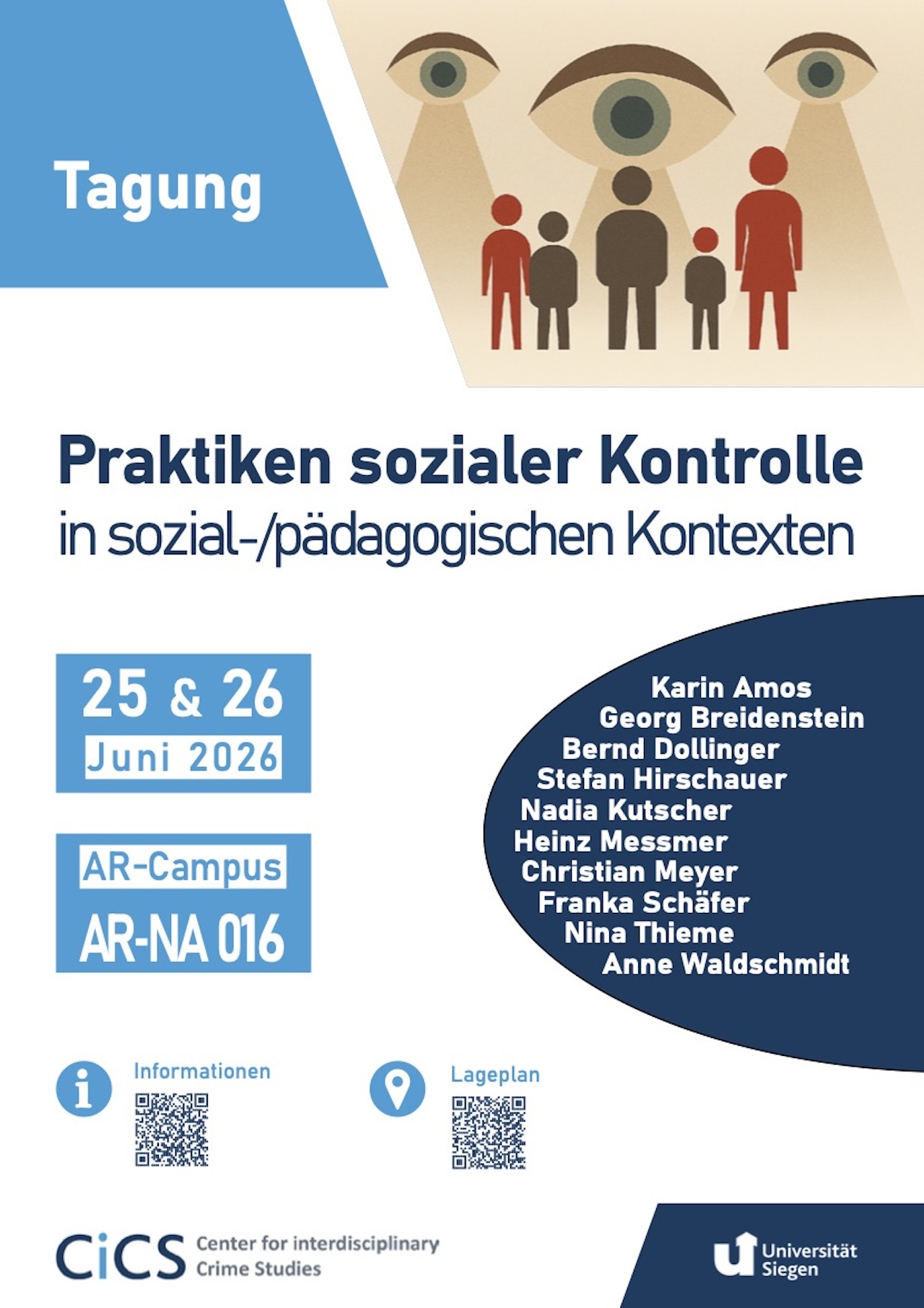
The research network brings together researchers from different disciplines who work on the complex topic of social control in the context of various pedagogical and social pedagogical measures.
Their shared focus is on the question of how social control is practically realised in contexts where young people are to be educated or supported (e.g. in child protection, in schools and teaching, in youth welfare services, in social pedagogical work with delinquent youths).
The intention is therefore to explore not abstract discourses on changes in security imperatives or control regimes, but the concrete interactive practices occurring in educational and social education contexts, in which control is realised.
This follows the realisation that these practical contexts follow their own logic, which cannot be derived from programmes or discourses, but requires a consistent focus on acts of action and interaction.
The empirical investigation and reconstruction of control practices in central institutions for the education and support of young people.
The focus is.
The development of a comparative systematic approach to highlight the similarities and differences in control practices across different types of care settings and institutions. The question is whether it is appropriate to speak, for example, of a particular „culture of control“ (Garland2001) in the present day, or similar phenomena, as far as pedagogical and social-pedagogical contexts are concerned.
The Theoretical Reconsideration of Education and Support from a Control Theory Perspective. The broad interdisciplinary debate on social control should be used to gain a novel perspective on social and pedagogical action and to theorise it, possibly with regard to historical changes.
Team - Researchers at KoPraks
We are an interdisciplinary research group from various universities that deals with practices of social control in educational – scholastic and extracurricular – contexts.
Prof. Dr. Bernd Dollinger
University of Siegen, Institute of Social Pedagogy; Centre for Interdisciplinary Crime Studies